
Russian verbs related to учить: meanings, differences, and usage
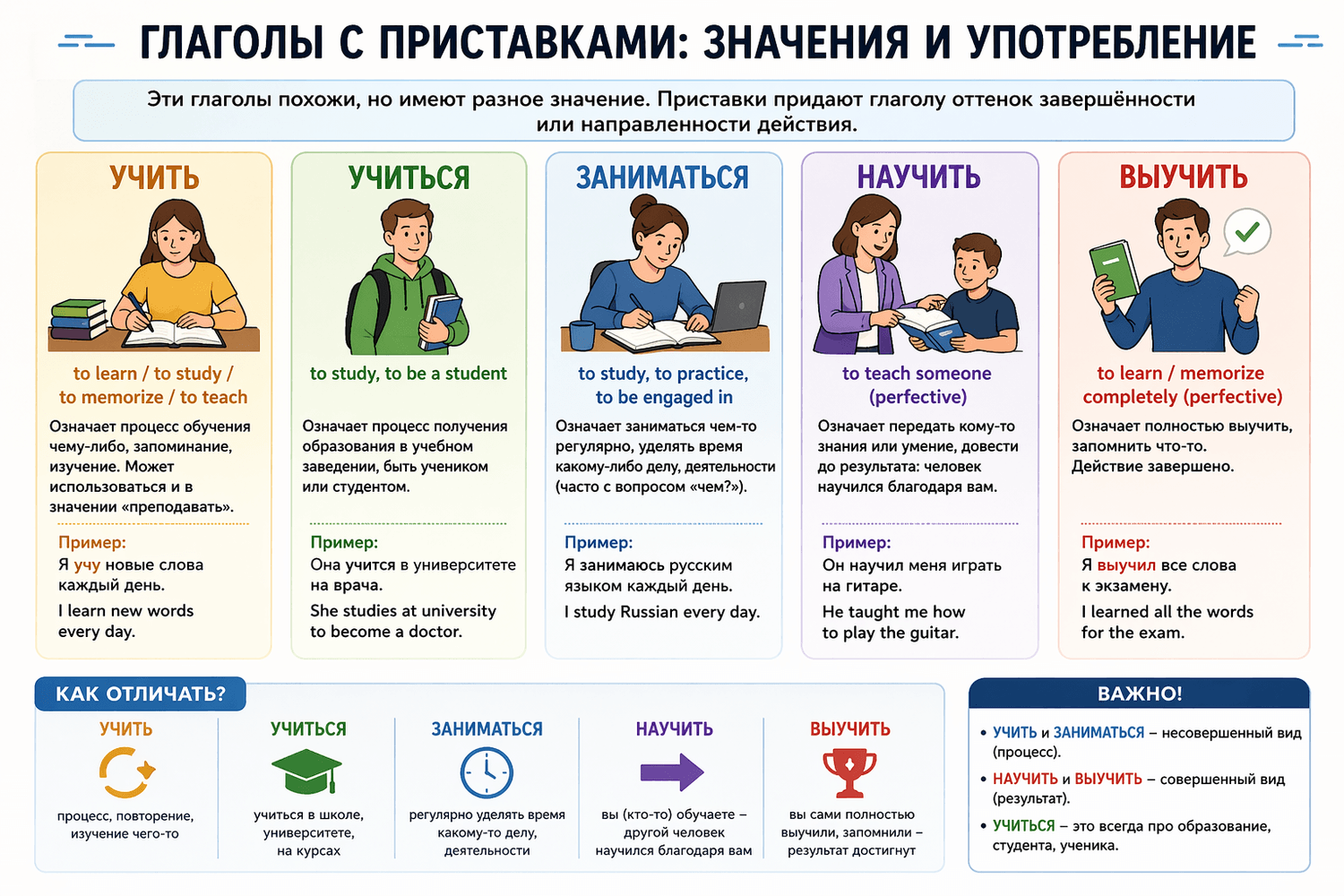
In Russian, several verbs revolve around the idea of learning, studying, or teaching, but they are not interchangeable. This is one of the most confusing topics for learners because English often uses just one or two verbs where Russian uses several.
The key verbs are:
учить, учиться, заниматься, научить, выучить
Understanding their differences will make your Russian much more precise and natural.
1. учить
This verb has two main meanings, which is essential to understand:
a) to teach
Used when someone gives knowledge to another person.
Examples:
Она учит детей русскому языку.
She teaches Russian to children.Мой отец учит математике.
My father teaches mathematics.
b) to study / to learn (actively, often by memorizing)
Used when you are working with specific material.
Examples:
Я учу новые слова.
I study / learn new words.Он учит правило.
He is studying a rule.Мы учим текст.
We are learning a text.
Core idea of учить
Focus on:
teaching someone, or
actively learning specific content
2. учиться
to study / to be a student / to be in education
Used for general education or being enrolled in studies.
Examples:
Я учусь в университете.
I study at a university.Она учится в школе.
She studies at school.Он учится на врача.
He is studying to become a doctor.
Core idea of учиться
Focus on:
being a student
being in the process of education
3. заниматься
to study / to practice / to be engaged in / to work on
This verb emphasizes regular activity and involvement.
Often answers: What are you working on?
Examples:
Я занимаюсь русским языком каждый день.
I study Russian every day.Она занимается спортом.
She does sports.Мы занимаемся грамматикой.
We are working on grammar.
Difference: учить vs заниматься
Я учу слова. → I learn words (specific content)
Я занимаюсь русским. → I study Russian (general activity)
Core idea of заниматься
Focus on:
regular practice
ongoing activity
dedication to something
4. научить
to teach someone (with result)
This is a perfective verb → it emphasizes that the person successfully learned.
Examples:
Он научил меня плавать.
He taught me how to swim.Учитель научил нас читать по-русски.
The teacher taught us to read in Russian.
Structure:
научить кого? чему?
научить кого? + infinitive
Core idea of научить
Not just teaching — but teaching with a result.
5. выучить
to learn completely / to memorize / to master
Also perfective → emphasizes completion.
Examples:
Я выучил все слова.
I learned all the words.Она выучила стихотворение.
She memorized the poem.
Difference: учить vs выучить
учить = process
выучить = finished result
Examples:
Я учу слова. → I am learning words
Я выучил слова. → I have learned the words
The key concept: process vs result
Process verbs:
учить
учиться
заниматься
Result verbs:
научить
выучить
This distinction is fundamental in Russian.
Clear comparison
учить
to teach
to study specific material
учиться
to study (in school/university)
to be a student
заниматься
to practice
to work on something regularly
научить
to teach someone successfully
выучить
to learn something completely
Common mistakes
Mistake 1: using учиться with specific content
❌ Я учусь слова.
✅ Я учу слова.
Mistake 2: using учить for general studies
❌ Я учу в университете.
✅ Я учусь в университете.
Mistake 3: confusing process and result
Я учу текст → I am learning it
Я выучил текст → I have learned it
Mistake 4: confusing учить and научить
Я учу детей → I teach children
Я научил детей читать → I taught them successfully
How to choose the right verb
Ask yourself:
1. General studies?
→ учиться
I study at university
2. Regular activity?
→ заниматься
I practice Russian
3. Specific content?
→ учить
I learn words
4. Teaching with result?
→ научить
I taught someone to do something
5. Completed learning?
→ выучить
I learned it completely
Final summary
учить = to teach / to study specific things
учиться = to study (as a student)
заниматься = to practice / to be engaged in
научить = to teach successfully
выучить = to learn completely
Core rule:
учить, учиться, заниматься → process
научить, выучить → result